Around March 15, 2013, a project in London England was being ensued to "improve the transport links" for the capital area. This was a £15bn project where everything became lost in the balance when construction workers found 12 human skeletons sitting 8 feet below ground. From historical records, it was later understood that in 1348, a graveyard had been opened in that location.
Within the record, there was a possibility shown which indicated that up to 50,000 human remains have been placed there in a time span of 3 years or less. The way in which these remains were laid out, in two separate roads, archeologists came to a revelation reminding them that at the Smithfield site, which was hit by the 'Black Death' was formatted in the same way. With some of the skeletons, different pieces of pottery were buried along side. This evidence points to the possibility that these skeletons were buried in the 14th century burial ground when the terrible plague swept the nation.
Because of this plague, around 1.5 million British citizens were lost as well as 25 million who became entangled in Europe. It was thought that this plague originated in Asia around 1346 and moved across its land into Europe around 1348-1350.
Since the initial discovery, it is said that 300+ skeletons have been found.
Tuesday, April 2, 2013

Friday, March 22, 2013
The Egtved Girl
 I have come upon an article about a female teenage skeleton found in Denmark. The remains are seen be as old as 1370 BC but when she passed, she was only twenty years old. Because the remains are well preserved, archaeologists have been able to identify not only her clothing, but her hair.
The picture shown below demonstrates the fashion of this time and gives us a better insight around her death and who she was. The circular orange item was thought to be a canister of some sort to hold liquid. This was further understood because of the remnants of liquid found inside. Her clothing is made out of wool and from further analysis, evidence of a ritualistic death was found.
These advances make me want to learn even more about this girl. The rituals her society had, who she was as an individual, and who tried showing respect to the body during burial (she was placed on cowhide with a wool blanket covering her.) From this, one could assume that she had high social status or that she had close relations with the individuals who buried her; it could also be seen as remorse.
 |
| Supposed outfit of the young teen |
Friday, March 15, 2013
Shot after Nightfall
From my title you might be guessing that this blog post will be about an actual shooting. In some way, this assumption is right. Let me explain...
The way one interprets a photograph can vary between cultures. There are different formal and aesthetic qualities about a photo that make it what it is. Because of this, the idea of content never seen in the exact same way.
There has been an uproar on photography and how it is used after death. Some questions that pop up are:
"In Belgium, it's acceptable to film the dead from Waterloo but not from WWI." That quote from the article can be seen in many different aspects. A question could be brought up to state what line has to be crossed in order to present an ethical fallout of a photograph; preserving the dignity of the individuals is said to be held at a high standard. The question of what dignity means could be brought up into question and what the borders are around it.
An archaeologist was quoted saying "The archaeology of the dead gives us a vivid insight into this [the past] without being ghoulish; and images of the dead should be part of our knowledge as much as wartime photographs of the battlefields..."These photographs tell a story and show a realistic idea of how the past was. Knowing that a photograph could lead to an identification could change one's mind about whether taking photos of the dead is permissible or not.
I personally feel that if a face is not shown, it would be easier to see a photo of someone who died many years ago but at the same time, I feel as if their life wouldn't be as honoured as it could be. It's hard to say whether or not photographing the deceased is right or wrong because it is hard to find the fine line that stands between.
The way one interprets a photograph can vary between cultures. There are different formal and aesthetic qualities about a photo that make it what it is. Because of this, the idea of content never seen in the exact same way.
There has been an uproar on photography and how it is used after death. Some questions that pop up are:
- When is the "proper" time to take a photo of someone who is deceased? (this can include the skelton)
- What types of photos could be seen as more ethically pleasing?
"In Belgium, it's acceptable to film the dead from Waterloo but not from WWI." That quote from the article can be seen in many different aspects. A question could be brought up to state what line has to be crossed in order to present an ethical fallout of a photograph; preserving the dignity of the individuals is said to be held at a high standard. The question of what dignity means could be brought up into question and what the borders are around it.
An archaeologist was quoted saying "The archaeology of the dead gives us a vivid insight into this [the past] without being ghoulish; and images of the dead should be part of our knowledge as much as wartime photographs of the battlefields..."These photographs tell a story and show a realistic idea of how the past was. Knowing that a photograph could lead to an identification could change one's mind about whether taking photos of the dead is permissible or not.
I personally feel that if a face is not shown, it would be easier to see a photo of someone who died many years ago but at the same time, I feel as if their life wouldn't be as honoured as it could be. It's hard to say whether or not photographing the deceased is right or wrong because it is hard to find the fine line that stands between.
Thursday, March 7, 2013
The Undying Sacrifice
Two days ago in class, we talked about the cemeteries located in Varna Necropolis, Bulgaria. I found the topic so interesting that I couldn't wait for next week to write another blog post. While trying to find more information on this topic, I stumbled onto another article which depicts a "Pyramid of Death" located in central Mexico.

It had all started with a community that had left their own town for refuge; there is no knowledge to explain why they had done this. It was thought that they might want to move because of a volcano that had destroyed part of their community but seeing that they re-located into an area where another volcano stood, this reason does not make sense. Their new home was in a location where no knowledge of the previous inhabitants existed. No articles were left behind in the search for previous life but there were different shards of pottery to understand the town that once was.
I found a video (it is a long video, but completely worth it) that explained more about the forgotten town in Mexico and about the pyramids that had been created. This particular video gave a theoretical account on the life of the individuals who relocated and their journey making the pyramid.
The part of this story that first caught my attention was the actual "Pyramid of the Moon." In this pyramid, individuals and animals would be sacrificed. The craziest part of all... they were seen to be buried antemortem. The bodies of the human and non-human individuals were stacked on top of one another in order to speak to the Gods. This was something the individuals hoped would bring them safety. In the video's depiction of building the pyramid, is was thought that "they're [the individuals] not being forced to with whips, they're building it because it's their responsibility of the state... it's their pyramid, their construction." (around 17:34)

It was later discovered that they had built pyramid upon pyramid; making them bigger and bigger with time. It was thought that they did this because they wanted to build something as big as the gods. The video explained previously goes into further detail on the town's society and the pyramids. I would love to keep writing about this because I could go on for days. I will now leave you with the thought that was on many archaeologists minds, about the location of the pyramid... why? I'm still trying to figure out how they built a pyramid in that day of age.

"Pyramid of Death"
It had all started with a community that had left their own town for refuge; there is no knowledge to explain why they had done this. It was thought that they might want to move because of a volcano that had destroyed part of their community but seeing that they re-located into an area where another volcano stood, this reason does not make sense. Their new home was in a location where no knowledge of the previous inhabitants existed. No articles were left behind in the search for previous life but there were different shards of pottery to understand the town that once was.
I found a video (it is a long video, but completely worth it) that explained more about the forgotten town in Mexico and about the pyramids that had been created. This particular video gave a theoretical account on the life of the individuals who relocated and their journey making the pyramid.
The part of this story that first caught my attention was the actual "Pyramid of the Moon." In this pyramid, individuals and animals would be sacrificed. The craziest part of all... they were seen to be buried antemortem. The bodies of the human and non-human individuals were stacked on top of one another in order to speak to the Gods. This was something the individuals hoped would bring them safety. In the video's depiction of building the pyramid, is was thought that "they're [the individuals] not being forced to with whips, they're building it because it's their responsibility of the state... it's their pyramid, their construction." (around 17:34)

Body of an animal found in the pyramid
It was later discovered that they had built pyramid upon pyramid; making them bigger and bigger with time. It was thought that they did this because they wanted to build something as big as the gods. The video explained previously goes into further detail on the town's society and the pyramids. I would love to keep writing about this because I could go on for days. I will now leave you with the thought that was on many archaeologists minds, about the location of the pyramid... why? I'm still trying to figure out how they built a pyramid in that day of age.
Tuesday, March 5, 2013
An Intact Aftermath
I was doing some research on the preservation of bodies when I came across this blog post. The body of Jeremy Bentham is described and some indication of its preservation is given. The idea that some bodies can be preserved so precisely is something many anthropologists crave to understand. Even though Bentham's head was not preserved as well as the rest of his body, it is still a miraculous thing. From this idea, I started to think about other cases of preservation and how they are represented today. The national geographic was one of my first locations in which I searched for answers.

In my research, I came upon a particularly interesting case that began in "Ancient Roman Life" around 79 A.D.. This particular man was located after a volcanic eruption within Mount Vesuvius which made the town of Pompeii its home. The frozen degree of the mountain, over several years, was able to preserve the bodies of many individuals who fell upon this dire fate. Up until 1748, no research had been done on the Mount Vesuvius eruption. It was not until the 1870's when the town of Pompeii started to clean the eruption's mess but to this day, the entire town has not been cleared.With the excavation of the site, archaeologists are trying to leave the area intact to preserve what they can.

After reading this article, I was so intrigued about the idea of preservation and how it can last for such an incredible amount of time. It's amazing that these individuals are in such dramatic poses and that they have been able to stay intact with so much detail. They seem so life like; its as though they are not as old as we may believe them to be. I hope that one day the town of Pompeii could be intact once again and that the mystery of these preservation's and the mountain catastrophes could be solved completely.

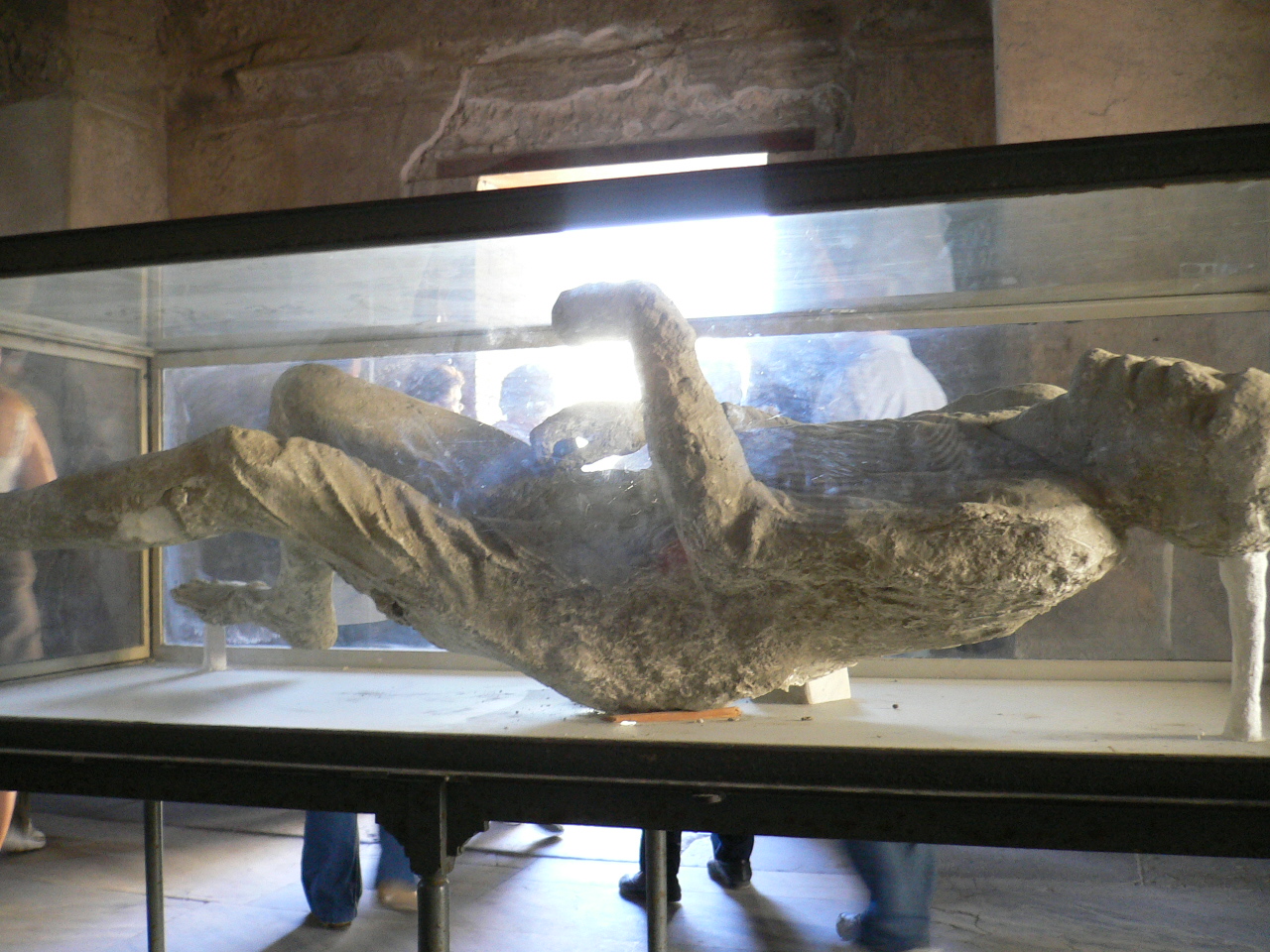
A preserved body within Mount Vesuvius

The deserted town of Pompeii
After reading this article, I was so intrigued about the idea of preservation and how it can last for such an incredible amount of time. It's amazing that these individuals are in such dramatic poses and that they have been able to stay intact with so much detail. They seem so life like; its as though they are not as old as we may believe them to be. I hope that one day the town of Pompeii could be intact once again and that the mystery of these preservation's and the mountain catastrophes could be solved completely.
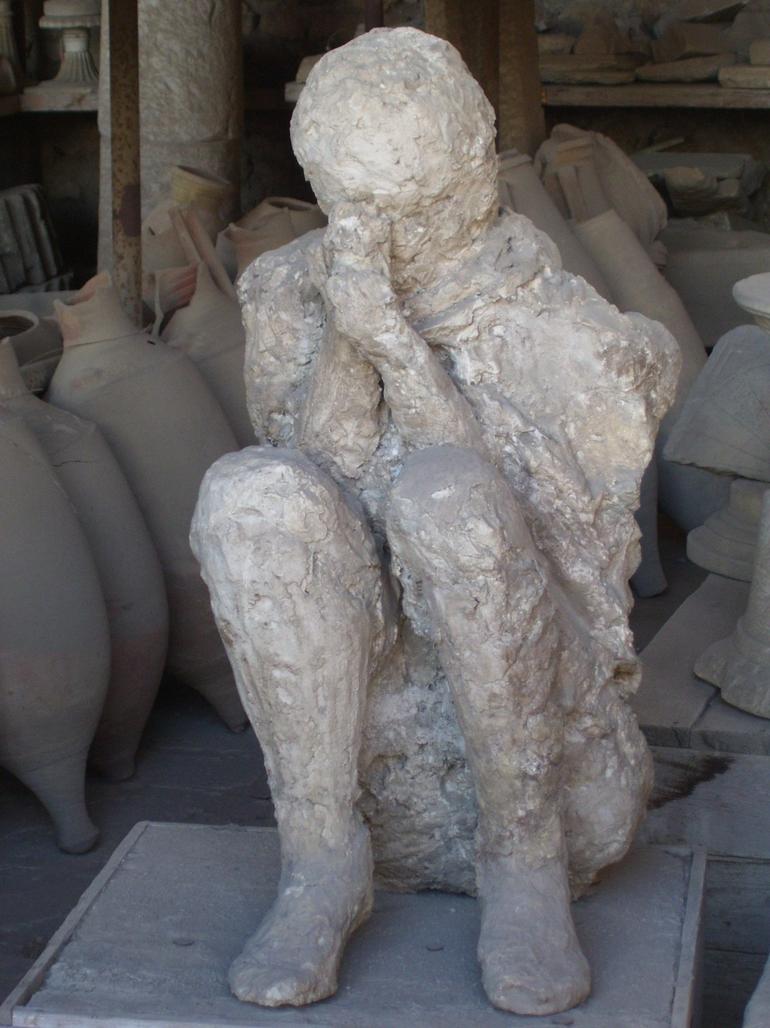
A preserved body found in the Mount Vesuvius
Friday, March 1, 2013
A "Monumental" Anaylsis
A few weeks ago my Archaeology of Death class was asked to do a monument analysis. With this task, it was meant for us to understand the use and functionality of data collecting. It also demonstrated the need of grave site analysis which is what we did. For my groups project, we decided to visit the Chinese Cemetery located in our city. Even though I have been going to school in this city for the past couple years, I'm not very familiar with the cemetery's here.
For our main research, we focused on the presence of the English language and how it was incorporated into the Chinese environment. With this, it was learned that less then a quarter of the grave monuments contained English writing. For those that did, it was seen to be a consistent addition to the primary stone that could be identified. Many of the grave markers we payed close attention to involved a primary and secondary stone. From the look of each of those grave markers, it was easy to tell that the secondary stone did not have much pollution deposits because they were not introduced into the grave site long ago.
Doing this research made me think about the influence on Chinese culture integrating with English. In many cases, the dominant culture overruns the sub dominant culture. It is though the dominant culture has an incredible hold on society and it will, metaphorically, step on anything that gets in its way. But that's just one theory.
For our main research, we focused on the presence of the English language and how it was incorporated into the Chinese environment. With this, it was learned that less then a quarter of the grave monuments contained English writing. For those that did, it was seen to be a consistent addition to the primary stone that could be identified. Many of the grave markers we payed close attention to involved a primary and secondary stone. From the look of each of those grave markers, it was easy to tell that the secondary stone did not have much pollution deposits because they were not introduced into the grave site long ago.
Doing this research made me think about the influence on Chinese culture integrating with English. In many cases, the dominant culture overruns the sub dominant culture. It is though the dominant culture has an incredible hold on society and it will, metaphorically, step on anything that gets in its way. But that's just one theory.
Saturday, February 9, 2013
Mummies
I've been pretty interested in the idea of mummies and mummification. After our last class, my interest grew so I decided to look up some videos that relate.
The first one is about the process of Mummification in a present day context.
The second video is about the aftermath of doing a mummification on a present day individual.
Mummification is an intense process that has dated back to ancient Egypt. It was process used to preserve bodies throughout time. Even though some attempts failed, many were successful which allowed scientists to learn more about it.
Would you want to be mummified?
The first one is about the process of Mummification in a present day context.
The second video is about the aftermath of doing a mummification on a present day individual.
Mummification is an intense process that has dated back to ancient Egypt. It was process used to preserve bodies throughout time. Even though some attempts failed, many were successful which allowed scientists to learn more about it.
Would you want to be mummified?
Subscribe to:
Comments (Atom)